

In February 1970, a 23-year-old American was hiding on the island of Timor with a butterfly net. He was under indictment back home for smuggling hashish. His cover story was that he was a graduate student collecting insects for a degree, and it held up well enough that he actually collected the insects. A year later he was standing in a cow pasture in the Colombian Amazon with his little brother, eating mushrooms, about to have the experience that would turn him into the most famous voice on the subject for the rest of the century.
His name was Terence McKenna. You have heard it, probably attached to a quote. This is the life behind the quotes, and the brother, Dennis, who was there for the most important part of it and spent the next fifty years quietly checking the math.
The short version
- Two brothers from a Colorado coal town. Terence read Jung at fourteen and found Huxley at sixteen.
- Berkeley, a DMT experience that “set his compass for life,” then Nepal, a seized hashish shipment and a year as a fugitive in Indonesia.
- 1971: the brothers go into the Amazon looking for one plant and come back with mushroom spores and a story neither of them ever stopped telling.
- Terence became the voice that kept mushrooms in the conversation while research was frozen. Dennis became the scientist who helped unfreeze it.
Interactive timeline
Two brothers, one jungle
Tap a chapter of their lives, then tap any moment for the story. The dark one is where it all turned.
1971
La Chorrera
They went into the Amazon looking for one thing and came back with another. Everything after this comes from these few weeks.
24
Terence’s age at La Chorrera
20
Dennis’s age
100k+
copies of the grower’s guide that followed
Tap through their lives above. Below, the long version, in order.
Two boys from a coal town
Terence Kemp McKenna was born on November 16, 1946, in Paonia, Colorado, a town of about 1,500 people on the Western Slope that he summed up as cattle and coal mining. His brother Dennis came along four years later, on December 17, 1950. Terence was the kid in the canyons with a fossil hammer and a butterfly net, and the kid in the library reading things nobody had assigned.
Around fourteen he picked up Carl Jung’s Psychology and Alchemy, which is not a normal thing for a fourteen-year-old in a mining town to do. He was sent to California for high school (a year with family friends in Los Altos, then Lancaster) and there, in 1963, he found Aldous Huxley’s The Doors of Perception and Heaven and Hell. Huxley described a world on the other side of the mind’s usual filter. Terence decided, more or less on the spot, that he wanted to go there.
Dennis, meanwhile, was the younger brother in the classic sense: audience, sidekick, test subject for whatever Terence had just read. That relationship, the talker and the listener, the leap and the check, is the thread through everything that follows.
Berkeley, and the room he spent his life trying to describe
In 1965 Terence enrolled at UC Berkeley and got into the Tussman Experimental College, a small two-year program built around reading the great books together and arguing about them. It was the perfect school for him and the perfect moment: Berkeley in the mid-’60s, when the questions Huxley had raised were being asked out loud on every corner.
In 1967 his best friend, Rick Watson, introduced him to DMT. It was brief, overwhelming and, by his telling, populated. He said later it set his “auto compass for life.” That is the most important sentence for understanding him. Everything he did afterward (the travel, the reading, the Amazon, thirty years of talking) was an attempt to get back to that room and figure out what was in it.
Smuggler, fugitive, butterfly collector
His first theory was that someone already knew the answer, and that they were probably in the Himalayas. In 1969 he went to Nepal to study Tibetan painting and to find shamans of the old Bön tradition, the religion that was in Tibet before Buddhism. He learned Tibetan. He also financed the trip by smuggling hashish, a fact he told audiences himself for decades, with no particular embarrassment.
In August 1969 one of his shipments was intercepted by U.S. Customs. He was indicted at home and simply didn’t go back. Instead he drifted through Southeast Asia and into the outer islands of Indonesia, where he made a living collecting butterflies: the same thing he had done as a boy in Colorado, now for money, now as a cover story. By February 1970 he was on Timor.
It is easy to read this part as a wild-youth detour. It isn’t. It is the same search, run the only way a 22-year-old with no money and no credentials could run it: go where the old knowledge is supposed to be, and pay for it however you can.
Why the Amazon
Then, in 1970, their mother died of cancer. Terence came home. And the two brothers, grieving, restless, both of them now obsessed with the same questions, started planning a trip together.
Here is what actually sent them to South America. They had read the reports of ethnobotanists like Richard Evans Schultes about plants used by peoples of the Amazon, and they had fixed on one in particular: oo-koo-hé, a preparation of the Witoto people that was said to contain DMT and, unusually, to work when swallowed. If Terence’s compass pointed at that DMT room, oo-koo-hé was a door you could walk through more slowly, with your eyes open. That was the plan: find it, try it, understand it.
In early 1971, Terence (24), Dennis (20) and three friends rode a barge down the Río Putumayo into the Colombian Amazon, headed for a Catholic mission town called La Chorrera.
La Chorrera
They didn’t find much of the oo-koo-hé. What they found instead was growing in the cow pastures around the mission: cubensis mushrooms, big and golden-capped, sprouting out of the dung of the mission cattle. They started eating them, and within days the original plan was forgotten.
What came next is the most argued-about episode in either of their lives, and the honest way to tell it is the way they did: as two different stories. On March 4 and 5, 1971, convinced they could push the experience further, the brothers attempted what they called “the Experiment”: an attempt to fuse the mushroom with harmine, a compound from the ayahuasca vine, using their own voices, in a held, buzzing tone they believed could change what was happening inside them. Terence came out of it saying he had made contact with something he called the Logos, a voice that taught him. Dennis came out of it lost. For weeks he was unmoored from ordinary reality, and Terence stayed with him in the jungle and took care of him until he came back.
Terence wrote his version in True Hallucinations (1993): a cosmic adventure story. Dennis waited forty years and wrote his in The Brotherhood of the Screaming Abyss (2012): the story of a younger brother who nearly didn’t come home, and an older one who wouldn’t leave him. Read together, they are one of the strangest and most loving accounts of brotherhood ever published.
The part nobody thought was important at the time: before they left, they collected spores from those pasture mushrooms and carried them back to the States. It looked like a souvenir. It turned out to be the most consequential thing either of them ever brought home.
Bringing it home
Back in California, Terence returned to Berkeley in 1972 and finished his degree in 1975, in a field he more or less designed for himself: ecology, shamanism and the conservation of natural resources. The same year the brothers published their first book together, The Invisible Landscape, a dense and genuinely weird attempt to explain La Chorrera through the I Ching, brain chemistry and the nature of time. And Terence began his life with Kathleen Harrison, an ethnobotanist who became his wife and partner in the next chapter.
But the thing that changed other people’s lives was more practical. Working in Berkeley with the La Chorrera spores, the brothers worked out a way to grow the mushrooms indoors. In 1976 they published it as a small magic-mushroom grower’s guide, under the pen names O.T. Oss (Terence) and O.N. Oeric (Dennis). It was fussy, the yields were modest, and it required patience and a pressure cooker. It didn’t matter. Until then, if you wanted mushrooms you went to Mexico or you knew someone. Now you could grow them in a closet. A revised edition went on to sell more than 100,000 copies.
Dennis took the other road out of La Chorrera. He went to school, and kept going: a master’s in botany from the University of Hawaiʻi in 1979, then a doctorate from the University of British Columbia in 1984, on the chemistry of the very Amazonian plants that had sent them south in the first place. Same jungle. Different instruments.
The voice inside the Gap
If you read our history of psychedelics, The Gap, you know what the 1970s and ’80s were like for this field: Nixon’s Controlled Substances Act, mushrooms in Schedule I, and roughly twenty-five years with no approved human research in the United States. The scientists went quiet. Terence didn’t.
He started giving talks in the early 1980s and never stopped. Esalen, bookstores, festivals, conferences, living rooms. The talks were recorded on cassette and copied and passed hand to hand, and later uploaded and remixed. He had a voice built for it: nasal, rapid, funny, ornate, capable of turning a sentence into a three-minute spiral and landing it perfectly. For a whole generation, he was the only person talking about mushrooms in public with any depth at all.
The ideas came with him, some of them lasting and some of them not:
- “Five dried grams in silent darkness.” His “heroic dose” (a big dose, alone, eyes closed, no distractions) is the most quoted dosing advice ever given. It was never meant as a starting point, and he said so.
- Food of the Gods (1992) and the “stoned ape.” The idea that early humans eating mushrooms helped spark language and consciousness. It is a wonderful story; scientists have never accepted it, and it is best read as a provocation rather than a finding.
- Timewave Zero. Built from the I Ching after La Chorrera, turned into software in 1987: a graph of “novelty” pointing at December 21, 2012, as the moment history would peak. Even his friends called it his wildest idea. The date came and went.
- Nature loves courage, and culture is not your friend. The lines people actually put on their walls are about trusting your own experience over whatever you were told to think, which, in the middle of the War on Drugs, was the radical part.
In 1985 he and Kathleen founded Botanical Dimensions on the Big Island of Hawaii, a preserve for the medicinal and sacred plants of the tropics: a living library, still there today. Through the ’80s he held long public conversations with biologist Rupert Sheldrake and mathematician Ralph Abraham, later published as Trialogues at the Edge of the West. And in the early ’90s a new generation found him in the strangest possible place: dance music. The Shamen put his voice on a single, and his lectures were sampled in warehouses. The bard of the mushrooms became, for a moment, a rave MC.
The botanist
Here is the half of the story that gets left out because it is quieter. In 1993, while Terence was filling lecture halls, Dennis was in Manaus, Brazil, coordinating the Hoasca Project, the first serious study of what happens to people who drink ayahuasca regularly for years. The answer, in a small group of long-term members of a Brazilian church, was that they were fine, and in some measures better than fine.
The same year, Dennis was on the founding board of the Heffter Research Institute, a small foundation created to fund rigorous research on psychedelic medicine at a time when the government wouldn’t. If you read The Gap, you have met Heffter: its money is behind much of the work that finally reopened the door, including the early studies at Johns Hopkins. One brother kept the idea alive in public. The other helped build the scientific road back.
Terence was the bard: the voice, the leap, the theory too beautiful to check. Dennis was the botanist: the one who checked. They disagreed about Timewave, about La Chorrera, about how much of it was real. They also needed each other, and both of them knew it.
The last year
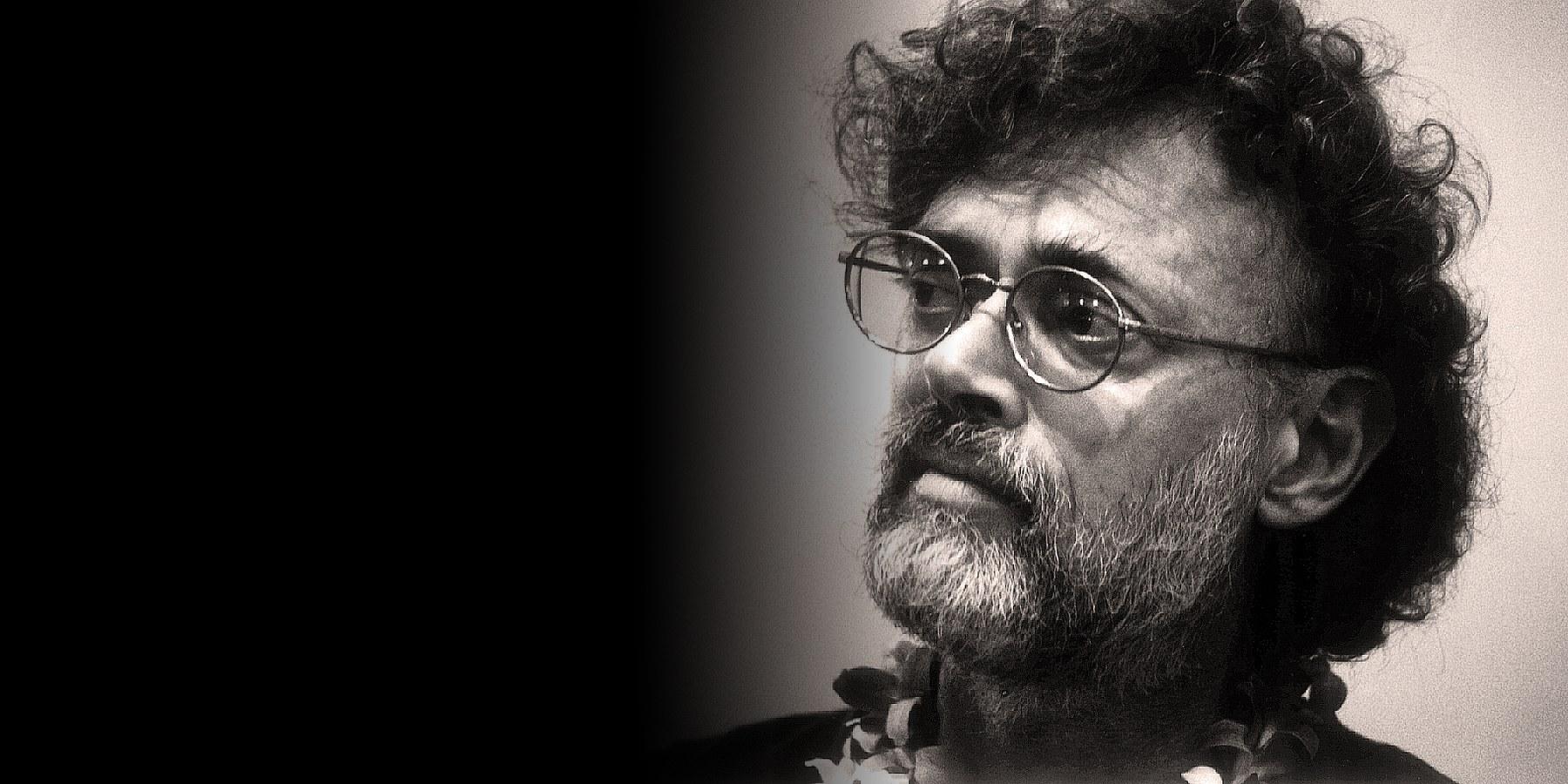
On May 22, 1999, after days of severe headaches, Terence collapsed with seizures. The diagnosis was glioblastoma, the most aggressive kind of brain cancer. He was 52. The photograph at the top of this page is from that same year, at a conference in Kona, Hawaii, a lei around his neck.
He spent his last months doing what he had always done: talking. In an interview with the writer Erik Davis, he spoke about his own death with what sounds, reading it now, mostly like curiosity. He died on April 3, 2000, at a friend’s home in San Rafael, California. He was 53, twelve years before the date his Timewave pointed to.
In 2007 a fire destroyed his library: more than 3,000 rare books and his notes. What survives is an index that Dennis had kept. It is hard to think of a more fitting image for the two of them.
Why his name is everywhere
Terence McKenna wasn’t a scientist, and he would have been the first to say so. He was something the field didn’t have and badly needed during the years it was silenced: a storyteller who took the experience seriously and made other people want to understand it. When the research came back (Johns Hopkins in 2000, the 2006 paper that restarted everything, UCSD and Imperial College and the rest) it came back into a culture that had never stopped asking the questions, partly because he never stopped asking them out loud.
And Dennis is still at it: teaching, writing, running the McKenna Academy of Natural Philosophy, and telling the other half of the story. Two kids from a coal town in Colorado. One went looking for the room and talked about it for thirty years. The other went looking for the chemistry and is still in the lab.
Who was Terence McKenna?
An American writer, speaker and ethnobotanist (1946–2000), born in Paonia, Colorado. He became the best-known public voice on psychedelic mushrooms from the 1980s until his death, through his talks and books like Food of the Gods and True Hallucinations.
Who is Dennis McKenna?
Terence’s younger brother (born 1950), an ethnopharmacologist with a doctorate from the University of British Columbia. He coordinated the 1993 Hoasca Project on ayahuasca, was on the founding board of the Heffter Research Institute, and wrote The Brotherhood of the Screaming Abyss about their lives.
Why did the McKenna brothers go to the Amazon?
In 1971, after their mother’s death, they went to the Colombian Amazon looking for oo-koo-hé, a Witoto preparation said to contain DMT and to work when swallowed. At La Chorrera they found cubensis mushrooms growing in cow pastures instead.
What happened at La Chorrera?
In March 1971 the brothers ran what they called “the Experiment,” trying to combine the mushroom with harmine using a vocal technique. Terence said he made contact with something he called the Logos; Dennis was disoriented for weeks while Terence cared for him. Both later wrote books about it.
Did Terence McKenna invent home mushroom growing?
Not alone, but he and Dennis were among the first to make it practical for regular people. Their 1976 grower’s guide, written under the pen names O.T. Oss and O.N. Oeric, used spores from La Chorrera, and a revised edition sold more than 100,000 copies.
What is the “heroic dose”?
Terence’s phrase for five dried grams taken alone in silent darkness. It is a large dose and was never meant as a starting point. Start low, have a sitter, and work up slowly.
How did Terence McKenna die?
Of glioblastoma, an aggressive brain cancer, diagnosed after seizures in May 1999. He died on April 3, 2000, in San Rafael, California, at 53.
Did he say “the universe is not only stranger than we suppose, but stranger than we can suppose”?
That line is usually credited to him, but it is a paraphrase of the British biologist J.B.S. Haldane, who wrote in 1927 that the universe is “not only queerer than we suppose, but queerer than we can suppose.”
Sources
- Terence McKenna, Wikipedia
- Dennis McKenna, Wikipedia
- Dennis McKenna, “The Experiment at La Chorrera: A 50-Year Retrospective”, McKenna Academy
- Terence McKenna interview, OMNI Magazine (May 1993)
- Erik Davis, “Terence McKenna’s Butterflies”, Techgnosis
- The 1976 grower’s guide, Erowid library
- The Hoasca Project, UDV
- Heffter Research Institute, Dennis McKenna
- Header photo: Jon Hanna, Terence McKenna at the AllChemical Arts Conference, Kona (1999), CC BY-SA 3.0
Ready to explore?
Find your perfect product.
Browse our full lineup of gummies, chocolates, teas, and softgels — all precisely dosed and delivered same-day in San Diego.
Comments
Loading…